I don't typically reply to older threads, but since you asked, here's a portfolio analysis.Desired Asset allocation: 50% stocks / 50% bonds; Vanguard's risk quiz/questionnaire led me to the ratio.
Desired International allocation: possibly 28% US/22% International
Total portfolio: ~2.45M
I'm not sure how you arrived at 28% US and 22% Int'l as that's a tilt towards Int'l at 44%, while the world-cap weight is about 38% int'l (see Van World Stock Index VT, Portfolio Composition/Markets). For now, I've left your desired int'l exposure at 44% (specifically 28% US and 22% int'l out of 50% total in stocks), but you might want to consider just using 40% as a round number closer to the world-cap weighting of US and ex-US.
Your Current layout is incredibly complex & cluttered at 43 holdings. You have issues with potential Wash Sales (highlighted in red) since VTI & VXUS are in both Taxable and His Roth IRA (includes VTIAX in Taxable since that's "substantially identical" to VXUS, just a different share class). There are two individual stocks, which are higher risk than a broadly diversified index (highlighted in blue). All of Her holdings with Raymond James (RJ) are high-cost with an expense ratio (ER) higher than 0.30%, plus a 1.00% AUM on top of those high-cost funds and that is seriously damaging her total return (see "costs matter" below); these are highlighted in yellow with the ER in red and should be replaced with a low-cost index fund, since 94% of Active Managers Failed to Beat the Market for 20 Years, so these actively managed fund picks by the RJ advisor are most likely to just add cost without adding value to beat the market. Her Taxable holding in American Funds Growth & Income has bonds & cash, but ideally Taxable (and Roth) should be 100% stocks to adhere to Tax-Efficient Fund Placement and all bonds & cash should be held in Trad Tax-Deferred accounts. These tax-inefficient placement issues are highlighted in purple. To be fair, the VPAS guys know you need bonds and they only have your Taxable and Roth accounts to work with; if you rolled over your Trad 401k & DCP, they would likely move the bonds there and make the Roth 100% stocks, but you're asking for a Bogleheads review and if you can self-mange, then even VPAS is probably not worth keeping at 0.30% AUM (VPAS still put too many bond funds, all they needed was BNDW, but they used BND, BNDX and BSV/BIV/BLV which is totally overlapped with BND).
The Proposed layout is an ideal 3-Fund Portfolio, implemented in his Trad R/O IRA (after the 401k & DCP land at Vanguard, while all other accounts just hold a single fund. Accounts were consolidated at Vanguard (one Trad IRA each for him & her; one Roth IRA for him; one joint Taxable for both). I said "ideal" because this is what I'd recommend if there were no tax-cost to cleanup the Taxable account, but there is a Tax Cost to Switch Funds, so consider if the cost of simplification is worth it or if you want to retain the low-cost clutter (her RJ account really should be closed and those funds transferred to Van and for the Her Trad IRA that's no cost impact, other than maybe an account closing fee from RJ). In Taxable, all the US "clutter" was consolidated to VTI and VTIAX was converted to VXUS, so that VTI & VXUS are the only holdings there. Do not add more to VXUS as it's not nearly as tax-efficient as VTI (ideally all int'l stock would be in Trad and/or Roth so Taxable is 100% VTI). His Trad IRA holds VOO, VEU, and BND which avoids wash sales with VTI and VXUS in Taxable (you could swap VOO to ITOT if you really want a "total" US stock funds, but S&P-500 is certainly good enough as it's 85% of the composition and nearly 95% of the performance). Her Trad IRA is just BND and His Roth IRA is just VOO (or could be ITOT). That exactly meets an AA of 50/50 with 44% of stocks in int'l and greatly simplifies from 43 holdings down to 7!
"Simplicity is the master key to financial success." -- John C. Bogle

A template spreadsheet (not your data) to help with asset allocation assessment and rebalance planning is linked below. Make a copy in your local GoogleSheets space to edit (or download to your local machine if you have Excel); I don't grant Editor access to sheets in my personal Google space. It should only take about 10-30 minutes once a year to update your balances and plan a shuffle among funds if any deltas are off by more than ±5% (or whatever your personal rebalance threshold is).
Asset Allocation Sheet
AA Current and Proposed
I don't have anything to add to the responses you already received for questions 1 through 3.
So if there's a personal relationship (the advisor is a friend or was recommended by family/friend and now there's a long history), she may feel like she's betraying the advisor if she leaves. That's part of the psychological trap that AUM-type advisors employ. They're nice to you, take your calls rather than put you on hold or shuffle you to an admin, reassure you, but they're robbing you blind. It's a business decision, so keep it simple with straight-forward logic and keep personal relationships out of paid professional advice. It's her money, so she has to come to this on her own, but here's the reasoning for avoiding AUM and high ER like the plague. 1-2% sounds tiny and you feel it's worth it. But it's 1-2% of your total assets, which are growing at a rate of around 10%/year. So that's effectively 1-2% on a 10% growth rate, which is a true cost of 10-20% of your future earnings (which is not so tiny!). This is how that high cost impacts your future net-worth.4. Raymond James IRA? Too complicated and costly in my view. 1% annual AUM and high expense ratios with some 'hybrid' funds. DW has personal relationship with the firm principals and trusts their guidance.
Costs Matter
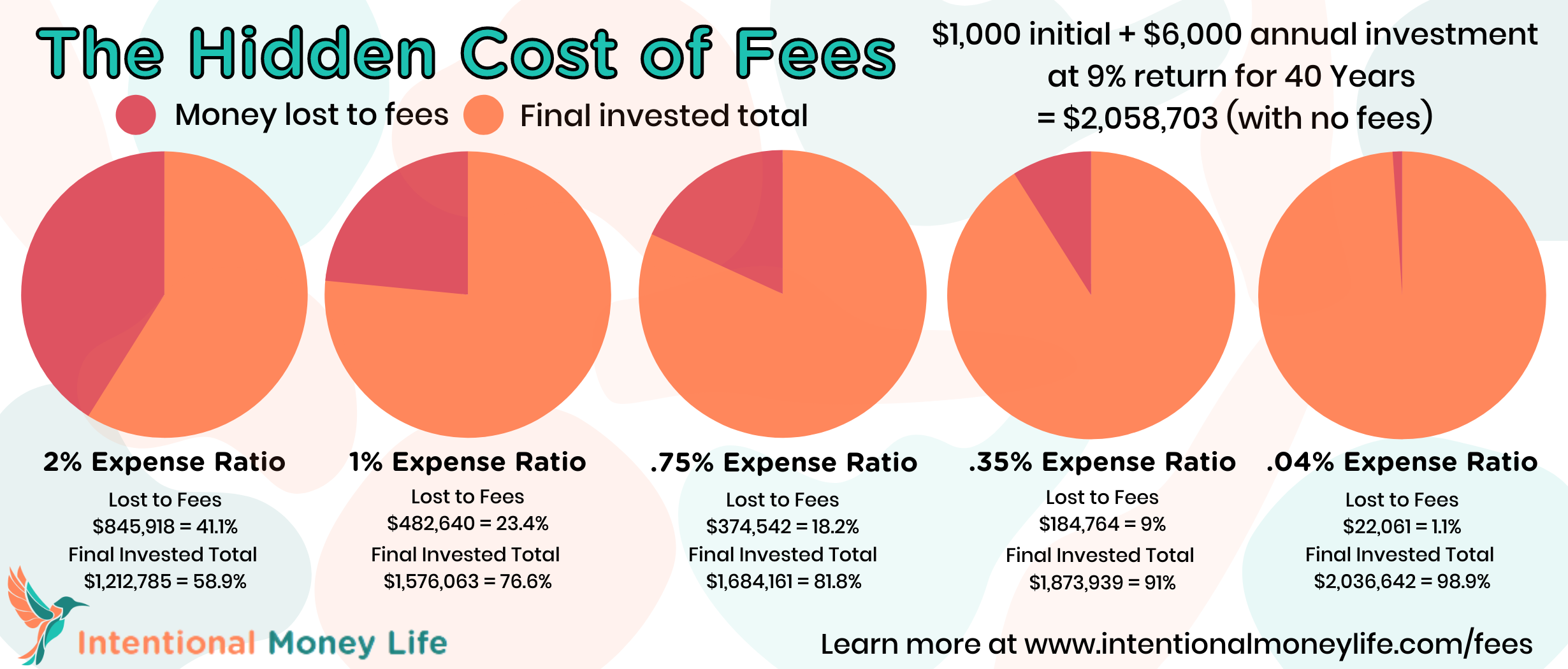

This is not about "you made a mistake and could've had such a bigger balance now." Nobody has a time machine. The point is that you're just entering retirement and hopefully have another 30 years to go and the next 30 years will be much more valuable with low-cost index funds than with high-cost active funds saddled by a 1% AUM. She has just shy of $346K with RJ. Let's say that the raw index return is around 8% for an AA of 50/50 (50% x 11.5% S&P-500 historical + 50% x 5.2 10y T-Notes historical) and that raw return is reduced by annual costs. We can use Excel's Future Value (FV) function to project the difference in balance which is her personal "lost to fees" number for the next 30 years with those assumptions.
FV(rate = 8% - 0.04%, period = 30 years, payment = $0/yr, principal = -$346K) = $3,443K; no AUM + low-cost index with ER = 0.04%
FV(rate = 8% - 1.71%, period = 30 years, payment = $0/yr, principal = -$346K) = $2,157K; AUM = 1.00% + Avg ER = 0.71%
Lost to fees = $1,286K!
If she wanted to leave her $346K as a legacy to her daughter (a contrived example for the sake of total cost comparison), then there would be ~$1.3M less if she stuck with RJ. That's also assuming the active funds can even keep up with the passive index, but only 6% of active fund managers pulled that off over a 20 year period (Warren Buffet of Berkshire Hathaway and Theo Kolotrones of Vanguard PRIMECAP are in that 6% club, but the trick is to pick the star manager who will outperform for the next 30 years, not the guy who's done it, retired and is no long managing that fund).
Money is fungible, and you have access to all your accounts (no "bridge" to age 59.5 or to SocSec), so you can take it from wherever it makes most sense. If you leave the low-cost clutter in Taxable, I'd probably spend those down to zero first and foremost (assuming the rest of Taxable is tax-efficient with minimal cash & bonds). Also see Draw-Down Priority5. In order, should we plan to harvest from(?): credit union CD's, VGD Cash+, VGD taxable, then VGD traditional IRA / RJames IRA?
Your combined Trad accounts are close to $2M. I've heard rough guidance the more than $1M in Trad for MFJ is going to present a likely increase in tax rate when RMDs come due without some kind of Trad->Roth Conversions or priority spend-plan (e.g., 100% of annual portfolio draw comes from Trad, and Trad holds all the bonds & cash to slow growth of that account type). You mentioned CDs and other cash in Taxable. I'd probably move those to VTI as soon as feasible and then move a like amount of cash from stocks into a MMF within His Trad IRA (so your cash buffer is intact, it's just in a more tax-efficient location and helps slow growth of the Trad account). It's almost certain that one of you will pass before the other and that makes a big Trad account even worse (the survivor's AGI thresholds for tax-brackets will be cut in half and it's more likely that a jump at RMD would be two brackets, not just one).6. What blind spots do you see? What other issues may I be overlooking? I've thought about Roth conversions for the traditional IRA but don't have a plan yet. Do we need to be careful with income during ages 63-64 to avoid increased IRMAA? In 2025, I *think* MFJ: $212,000 or less: Standard Part B premium ($185) and plan premium for Part D.
I think given the size of your Trad accounts you're going to want to do conversions, so there's no avoiding an IMRAA impact unless you simply choose not do to any conversions (and take the tax hit at RMD age). Conversions before age 63 are fine, but given you were 62 last year, you're out of time to do conversions that would not impact IRMAA Tier Assignment. So a bit of a dilemma (champagne problems as I heard someone else call it). You can pay more for Medicare and defuse the RMD tax-bomb or you can avoid paying more now and hope that drawing solely from Trad will help with RMDs, but you're still likely to jump up a tax-bracket and the added AGI from RMDs may bump your IMRAA Tier at that time anyway. I have heard (but not confirmed) that you can appeal your IMRAA Tier assignment if it was a temporary situation (e.g., conversions for N years), but given the SSA is likely over-burdened, under-staffed, it's not a path I'd advocate, but if you did conversions from 63-65 and then at 67 could demonstrate that your AGI is much lower than the two-year lookback at 63-64, they might drop you to a lower IRMAA tier. I don't know how that works exactly but given your situation it might be worth researching.
Typically this decision is based on fuzzy projections of total taxes paid for various cases from retirement until life-expectancy age (e.g., 95 or 100). It's not particularly straight-forward to me, but there are spreadsheets and calculators in the Wiki topic on Trad->Roth conversion. Since you have VPAS on retainer, you could also ask them to analyze the benefit of conversions (whether, when, now much?) and give you a plan before you transition to a self-directed portfolio (or higher an advice-only CFP for a flat fee if you want to go DIY as soon as possible).
Statistics: Posted by bonesly — Wed Feb 04, 2026 1:35 pm — Replies 9 — Views 1450